Sunday, December 9, 2012

Kieu's Lament: Chock Full of Allusions


This passage is from lines 1251-1264. It is a relatively short passage compared to what I normally translate, but it is rich with metaphorical language. If may seem a bit cryptic upon first reading, but if you parse through the allusions then you’ll see that the message is pretty straight forward. I’ve included a few explanatory notes at the end.
Can be found here

                Kieu has already become fully acclimated with her life as a prostitute and she feels her spirit being hollowed out. At this point in the story she is lamenting the fact that she can’t provide for her parents, and that the love of her life may have forgotten about her or she may not be worthy of him anymore. This passage, along with the few dozen lines that precede it, are basically a preamble to her meeting her next lover, Ky Tam,  which I will translate eventually.

Feelings within her heart
That seemed so far removed
Within her found a groove,
The pain was hardly bearable,
Tangled and terrible:
“I miss those who I owe nine debts,*
Day by day the sun sets,
Slanting behind mulberry trees.*
Home is across the seas,
Far away and out of my reach,
Which god’s law did I breach?
How could my destiny be this?
The sopohoras’re amiss, *
Naive, too young, and immature
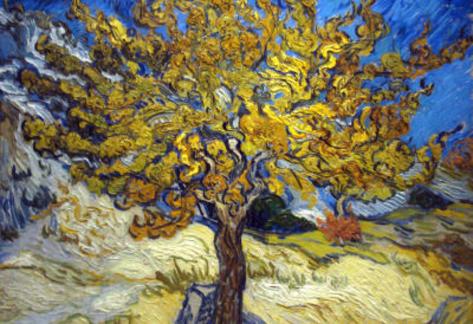
Van Gogh's Mulberry Tree
Can be found here
To provide, to insure
Our parents a comfortable life.
In spite of my trying strife,
I hath not forgotten my pledge
Of three lifetimes. This wedge
Of vast distance ‘tween him and I...
Has he just said goodbye?
He’ll come to find the willow’s branch
Was given for a tranche*
Of mere silver and golden coin.
Can our love ever join?
Will that flower ever bloom
On this branch, in this womb?

*The “nine debts” that she is referring to here are toward her parents. In Vietnamese they consist of sinh (birth), cúc (nourishment/support), phủ (comfort), súc (rearing), trưởng (≈growing up), dục (education), cố (keep safe), phục (teach about respect), and phúc (happiness). The concept of “nine debts” comes from Confucian tradition and comes from the 202nd poem of the Book of Odes. It’s important to keep in mind that Confucius did not write the Book of Odes; he only compiled and supposedly edited it.
I discovered my old copy of Ezra Pound’s translation of the Book of Odes and found the poem in question. It is titled “The Orphan” and details the despair of an orphan who has no familial support whatsoever. Here is a telling excerpt:
Weed or plant that gives no grain,
you two begat me in toil and pain,

Shamed the jug that fills no cup;
orphan’s life, proverb saith,
is worth less than early death.
Who sustaineth the fatherless?
Who stayeth the motherless?
Carry gagged grief beyond the court-yard wall,
In my house there is no one at all.

          It is a very gloomy poem. Confucius probably used it because it exemplifies why children with parents should be grateful. We can assume that Confucius codified the exact “nine debts” that we should be so concerned about.

*The reference to “mulberry trees” comes from Chiense proverbial sayings, mainly about patience. Mulberry trees are used to nourish silk worms and thus were very valuable. The image of the sun setting behind mulberry trees signifies the end of life. She is lamenting that while she is away in servitude her parent’s may be passing away.

Sophora Tree
Can be found here
*The mention of sophora trees harks back to an old story from Song Dynasty (960-1127 A.D.). The story was that a fellow named Wang Hu planted three sophora trees in his garden, one for each of his sons. The trees were meant to give his sons good luck. The metaphor is that if the “sophora trees” are growing well then the children of the family are successful and supporting their parents. In Kieu’s case her other sisters are still too young to support the family, and so she has anxiety that her parents are not being properly cared for.


Can be found here
*The willow’s branch refers to an old poem from the Tang Dynasty (618-906 A.D.) about a man who leaves his courtesan at home while he is out on a military campaign. His courtesan was named “Miss Willow” and lived on a street called Chang Terrace. On his return journey he wrote a poem addressed to her that included the line: “O Chang Terrace Willow/ Are you still fresh and green as you once were?” It turned out that she was already abducted by another general by the time he returned.
                Kieu is alluding to this because she has already given up her chastity and slept with so many men. Her purity, “willow’s branch”, was handed to other men for money. She is of course ashamed of this.

Thursday, November 1, 2012

Tu Ba Explains to Kieu how to be a Whore

Can be found here

This passage comes from lines 1199-1226. Kieu is still recovering from So Khanh's betrayal and Tu Ba decides to give her some advice. Tu Ba has a vested interest in Kieu finally submitting to her new profession in the brothel and so she takes on a more conciliatory tone. Kieu listens attentively because at this point she has no other option.

The moon shown brilliantly
Through the mirror-like window,
Tu Ba came, not as foe,
But as one offering advice.
-“The lover’s craft isn't nice,
Tis not an easy, carefree life,
Fortune’ll cut with its knife
If ladies don’t know how to play.”
-“Storms have blown me astray,
Risk my dignity? My own head?
“So be it...” Kieu said.
“Men are all the same,”  Tu Ba explained.
“Before the night has waned
They’ll spend their gold on what they want.
Tricks of the dilettante,
There’re tricks for when your first kissed,
Tricks for late night trysts.
You must learn them, by heart know these,
You’ll keep them up your sleeves,
Seven seductions to bring them in,
Eight tricks to keep’em herein.
Play like the flowering willow,
Comfort them on your pillow,
Don’t be afraid to cast them aside
When they can’t be plied
With more liquor and merriment.
Flirt until they’re spent,
Smile with the corner of your eye,
With your eyebrows make them buy,
Extol praise with him to the moon,
Jokes and jest are your boon.
Now you know the tricks of the house!
Go ahead and lift that blouse,
Become a master of this trade!”
Can be found here
Kieu heard the tirade,
And noted every last detail,
Her rosy cheeks went pale,
Pearly tears rolled off her face.
This life of lust and lace
Made her feel ashamed and shy,
How was she to get by
In such awful and frightening plight?
Pity the girl you might,
She has fallen from nobility,
Gone is her humility,
Now an apprentice to a whore.
How long is it, pore by pore,
For the shamelessness to crease
A youthful face,  feast by feast?
Is this what it has come to?
What window did she go through,
Alas, to be so lost and alone?

Saturday, October 13, 2012

Sở Khanh's Treachery and Kiều's Broken Spirit


Can be found here
This next passage of the Tale of Kieu comes from lines 1105-1148. At this point in the story So Khanh has convinced Kieu that he is trustworthy and will rescue her from being a sex slave at the brothel. They will depart clandestinely by horseback under the nose of her evil madam: Tu ba. 
I am also experimenting with a new format by having the Vietnamese text and English text side by side. I think it looks a bit better and is generally a better look for the blog. Let me know what you think. The whole passage is continuous. I just broke it up into two parts since it is broken up in the tale that way.


“I’m in your hands,” she said.
“Quickly, Please decide on a plan!”
“There are horses well ran,
They’re just outside,” He replied.
“A man whom I've relied,
Is also just around the bend.
Let’s go my lovely friend,
There’s no way but to leave,
By stealth we will achieve.
Although there may be gales, snow flurry,
I’ll be there, Don’t worry.”
Hearing his words she was chary,
Hoping she won’t be sorry,
She knew she was in too deep.
She resisted to weep,
Closed her eyes, and ventured on.
She’s in Fate’s hands now, a pawn.

Can be found here


They furtively escaped,
Fled on their horses single file.
They rode mile after mile,
The autumn night, began to fade,
The morning, to cascade.
Trees fell victim to thrashing gales,
Leaves scattered on the trails,
The moon was swallowed by the copse.
The grass was pale with drops,
Of dew. Kieu’s heart pined for one road,
To her home, her abode.
In harsh tones, the roosters crowed dawn,
A cry! Perhaps a yawn?
Behind, others were in hot pursuit!
With dark hunters en-route
Kieu’s soft heart pounded in her chest,
Feeling a tinge in his breast,
He grasped his bridle to flee,
So Khanh gave up this spree.
Kieu, alone, knew not what to do,
She trembled, her path askew,
Through the forest her mare dashed.
Heaven! Why've you thrashed?
How could you have such a cold heart?
Crumbled rose, fell apart...
A gang surrounded her on all sides,
There was nowhere to hide,
She couldn’t burrow into the ground,
Couldn’t fly, to the earth bound.
Madam Tu Ba swiftly descended,
She couldn't have defended.
Kieu was whisked back to her prison,
Tu ba’s fury had risen.
She asked no questions, no query,
Flailed Kieu ‘til her arm was weary.
Like a ragged tree branch, she beat her.
We’re all human, there’s no blur.
Flesh and bone, blood through our veins,
What rose feels no pain,
When one by one its petals’re torn off?
Can be found here
Kieu’s cries made Tu Ba scoff,
She lowered her bloodied head,
Begged her, for her life pled.
“My modesty as a woman...
Is gone, C’est fin.
My wish to return to my land...
Is gone, as you demand:
Now, here is home, always’ll be.
My existence is thee,
I am resigned to my lot,
Care for myself? Cannot.
How can an eel mind muddying its head?
My chastity is dead.”


Kieu has essentially given up on life, or at least is projecting that impression to placate Tu Ba. 
Also, the passage: "How can an eel mind muddying its head?" (Thân lươn bao quản lấm đầu) is a Vietnamese proverb which according to Huynh Sanh Thong is "meaning that a poor, helpless person my have to endure humiliation and degradation in order to save himself or herself and survive." I had to pretty much copy his translation for that one since the proverb is a bit cryptic for me and I thought it was good to go by his judgment. 
She will eventually escape from her servitude but it will be because of different man, who although is better than So Khanh, does have some serious short-comings.

Friday, October 5, 2012

Kieu meets Sở Khanh


These next passages detail more of Kieu's laments and introduce a new character: Sở Khanh. Kieu is still languishing in the brothel and is becoming more and more morose. Sở Khanh happens to be walking by and sees her silhouette. He hears some of her poetic laments and is extremely moved. Sở Khanh's arrival appears to be the first good news for Kieu after she's been imprisoned. But we'll see later just how objectionable he really is.
Can be found here

This first part is a sort of sad soliloquy by Kieu where Nguyễn Du uses imagery to describe her inner feelings. Each couplet starts with the words "Buồn trông....." which means either "Sadly looking..." or it could possible mean "Looking sad as though..." I translated it as "Sadly she gazed out," I interpreted it to mean she was gazing out at the scenery while in the depths of melancholy. I think this passage is quite nice and moving. 

Lines: 1047-1054
Buồn trông cửa bể chiều hôm,
Thuyền ai thấp thoáng cánh buồm xa xa?
Buồn trông ngọn nước mới sa,
Hoa trôi man mác biết là về đâu?
Buồn trông nội cỏ dàu dàu,
Chân mây mặt đất một màu xanh xanh.
Buồn trông gió cuốn mặt duềnh,
Ầm ầm tiếng sóng kêu quanh ghế ngồi.


Sadly she gazed out
Can be found here
Toward the lonely docks at dusk,
Was there a sailor brusque,
Was that a ships sail in the fog?

Sadly she gazed out
At the mountains of this new country,
Drifting flowers at sea,
How do they know their way back home?

Sadly she gazed out
At withering grass atop the mound,
The cloud banks and the ground
Blend in the distance to a pale green.

Sadly she gazed out,
The rolling waves , pushed by the wind
Roared! And would not rescind,
She dwelled amidst the tortuous sound.

I separated this couplet from the others because I felt like it to be more of an opening lament to which the passage follows. 

Lines: 1055-1056
Chung quanh những nước non người,
Đau lòng lưu lạc nên vài bốn câu.

In this world of ours
Those with a bleeding heart wander,
And only stop to ponder:
Why there should be so few of them?

This next passage describes the improbable meeting of Sở Khanh and Kieu. He is completely enamored with her and immediately "falls in love". We only here his side of the story at this point but Kieu does fall victim to his charm and in my next post I'll translate the scene which shows what kind of man he really is.

Lines: 1057-1072
Ngậm ngùi rủ bức rèm châu,
Cách tường nghe có tiếng đâu họa vần.
Một chàng vừa trạc thanh xuân,
Hình dong chải chốt, áo khăn dịu dàng.
Nghĩ rằng cũng mạch thư hương,
Hỏi ra mới biết rằng chàng Sở Khanh.
Bóng nga thấp thoáng dưới mành,
Trông nàng, chàng cũng ra tình đeo đai:
-“Than ôi sắc nước hương trời!
Tiếc cho đâu bỗng lạc loài đến đây!
Giá đành trong nguyệt trên mây,
Hoa sao hoa khéo đọa đày bấy hoa!
Tức gan riêng giận trời già,
Lóng này ai tỏ cho ta hỡi lòng?
Thuyền quyên ví biết anh hùng,
Ra tay tháo cũi sổ lồng như chơi”.
Can be found here

Drop by drop, pearls rolled
From her grieving eyes to the floor,
He heard her out-pour
And finished her sorrowful verse.
A young man he was first,
His appearance graceful,refined.
A scholar he seemed and kind,
She wished to know how he was called,
Sở Khanh, he replied enthralled.
Bathed in moonlight he stole a glance,
Their hearts began the dance
Of two lovers struck by Cupid’s arrow.
-“Alas! Struck to the marrow
I am! What a beauty you are!
Fit for a god, for a tsar,
How could you come to this pitiful place?
Her dignity, her grace...
Be a denizen of the moon, she should,
Delicate rose, treated like wood.
Heaven of old, showing its wrath!
What a terrible path!
Who can reveal the pain within
Your heart, which no one can win?
If only she knew that I’m that man
Who has a plan, save her I can.
I’ll set this caged bird free, I will!”

Friday, August 17, 2012

Kieu Languishing


This next passage is from lines 1033-1038 and happens shortly after her suicide attempt. She has been living as a prostitute in Tu Ba's terrible establishment. She is basically a sex slave at this point. Her constant preoccupation has been her family and her long lost lover Kim Trong. The following passage is a short one but I think captures her mood well.
I took more liberties with the translation and refrained from imposing any syllable restrictions on myself. I did try to keep a consistent rhyming scheme though. The painting is from Ngoc Mai and her collection depicting scenes in Truyen Kieu.


Trước lầu Ngưng Bích khóa xuân,
Vẻ non xa, tấm trăng gần, ở chung.
Bốn bề bát ngát xa trông,
Cát vàng cồn nọ, bụi hồng dặm kia.
Bẽ bàng mây sớm đèn khuya,
Nửa tình nửa cảnh như chia tấm lòng.

In her cloistered quarters
Known as the “Sapphire Wing”
She spent the Spring,
Where her innocence felt far away
Yet only the white sheets in which she lay
Felt close to her.
The immense four oceans, as far as they were,
The yellow sand dunes,
Felt closer and more in tune
With her, than this wretched, floating world.
Everyday, she felt ashamed as the days unfurled,
And the early clouds spread across the sky.
Her heart was divided between alarm and the affection’s lie.

Thursday, July 5, 2012

Kieu Attempts Suicide


Painting by Ngoc Mai

At this point in the story Kieu has finally realized that she has been sold to a brothel. She has a lot of things weighing on her mind right now. She was already feeling devastated because she was separated from her true love Kim Trong. Now she's realized that there is no way she can live a respectable life. For Kieu, suicide is the only option to preserve her dignity.

Nàng rằng- “Trời thẳm đất dày!
Thân này đã bỏ những ngày ra đi.
Sẵn dao tay áo, tức thì giở ra.
Sợ gan nát ngọc liều hoa,
Mụ còn trông mặt, nàng đà quá tay.
Thương ôi! Tài sắc bậc này,
Một dao oan nghiệt, đứt dây phong trần?

“Oh high Heaven! Depths of the Earth!” Exclaimed Kieu.
“I have given up...This body must be sacrificed, now and forever.
Alas! I have no regrets, none whatsoever!”
Tucked in her sleeve she had a knife ready, she swiftly took it out,
Shattered jade, wasting water in a drought.*
Tu Ba’s face was a pale, blank slate, Kieu bolted out of her way.
Alas! Beauty and talent, slaves to Heaven’s sway,
That wicked blade, can it cut the cord tying her to this life of adversity?

*The original Vietnamese line: nát ngọc liều hoa,literally means something like "smashing jade, tearing up flowers". It refers to someone who has no fear of death.

Kieu is then quickly rushed to a doctor who saves her life. In her stupor of despair and shame, a spirit/ghost visits her. This is the spirit Dam Tien who visited her in the beginning of the story. Dam Tien was another beautiful women who had a terrible life. They are kindred spirits apparently. 

Rỉ rằng: “Nhân quả dở dang,
Đã toan trốn nợ đoạn trường được sao!
Số còn nặng nghiệp má đào,
Người dù muốn quyết, trời nào đã cho?
Hãy xin hết kiếp liễu bồ,
Sông Tiền Đường, sẽ hẹn hò về sau.”

“Your destiny is unfinished.”A small voice said to Kieu. “You cannot escape your mortal debt!
The fate of a woman is heavy, full of strife, and yet
Can people merely choose a fortunate life? How could Heaven allow it?
You are not the willow tree, the yielding reed, don’t quit!*
We will meet again at Tien Duong River...”

*Willow tree's soft and reeds are yielding and according to my research, it is an old Vietnamese saying referring to a woman. Basically Dam Tien is trying to tell her to toughen up.

This is a passage heavy with Buddhist fatalism. Kieu supposedly is having such a hard time because of her bad karma. I think this kind of fatalism is pretty cheesy but it is very interesting and quite moving. 

Tuesday, July 3, 2012

Kieu Meets Tu Ba


In the last post we saw how Ma had taken Kieu under the pretext of marrying her but was actually trafficking her to the brothel owned by him and his actual wife, Tu Ba. After that passage, Kieu and Ma have their official wedding ceremony and Kieu laments to her parents. In between the last post and this one, not much happens plot-wise but we see Kieu and Kieu's parent's numerous lamentations and regrets. It's a very sad and sometimes profound part of the story but ultimately very depressing (like most of this tale). 
Ngoc Mai's painting depicting this scene. Can be
found here

By this point in the story Kieu has arrived at Ma and Tu Ba's brothel and is meeting Tu Ba for the first time. Their interaction is short but telling. Tu Ba is the archetypal evil bitch who has zero morals. She is laying the law down for Kieu and Kieu is understandably confused. In the following posts we will see Kieu's reaction and trust me, it's intense.

This time I decided to translated them in 12-16 syllable couplets because I found the 6-8 couplet structure a bit too difficult. I think this flows a bit better. I also kept the original rhyming scheme. I hope you enjoy this short passage.


951~960

Dạy rằng:- “Con lạy mẹ đây,
Lạy rồi sang lạy cậu mày bên kia!”
Nàng rằng:-“Phải bước lưu ly,
Phận hèn vâng đã cam bề tiểu tinh.
Điều đâu lấy yến làm anh,
Ngây thơ chẳng biết là danh phận gì.
Đủ điều nạp thái, vu quy,
Đã khi chung chạ, lại khi đứng ngồi.
Giờ ra thay bậc đổi ngôi,
Dám xin gửi lại một lời cho minh.”

Tu Ba gazed at Kieu: “Kneel before your mother!
Once you’ve paid homage, ‘fore your uncle bow your head!”
“I was torn from my family, my rightful homestead,
I’ve obeyed my humble fate, resigned myself a concubine.
Ma and I’ve married and together we did dine,
Perhaps in my naivety I don’t understand my standing.
He supplied the wedding gifts, gave the offering,
We mingled together, lay intimately as those married do.
After all that, you would change my rank, my value,
Please explain to me what sordid affair I’m in now!” Replied Kieu.